


Curved tempered glass: applications and design ideas
In contemporary architectural projects, where fluid shapes and smart materials define building aesthetics and performance, curved-secure glass is becoming an increasingly common choice. With its combination of organic design and structural strength, this type of glass allows you to create spectacular facades, glazed roofs, elegant interior partitions or shop windows with a striking visual impact.
Transparent Design offers you the possibility to integrate such solutions in your projects, using modern curving technologies integrated in the securing process. The result is glass with a fluid aesthetic, but also with technical performance that meets the most stringent modern building standards. Discover further applications and design ideas to harness the potential of curved-secure glass in modern commercial or large residential projects!
What is curved-secure glass?
Curved-secure glass is glass that simultaneously undergoes two technological processes: bending and toughening. In the first stage, the sheet of glass is heated to a temperature at which it becomes malleable and can be molded into the desired shape. It is then rapidly cooled in a controlled process that gives it up to five times the mechanical strength of ordinary glass.
This combination of curved shape and heat treatment makes glass a premium architectural material: aesthetically pleasing, safe and highly adaptable. In the event of breakage, the curved-secure glass shatters into small, sharp, non-sharp pieces, reducing the risk of injury – a key criterion for commercial and infrastructure projects.
Transparent Design produces bend-secure glass with automated bending modules integrated into the securing lines, allowing precise and uniform bends.
Curved-secure vs other types of curved glass
In the glass-processing industry, the difference between a classic curved glass and a curved-safe glass is not only about aesthetics, but mainly about technical performance and safety. Although both types involve shaping the glass at high temperatures to obtain a concave or convex shape, the cooling process and subsequent treatment define the final properties of the product.
Standard curved glass is made by heating and shaping a flat sheet of glass on a special mold, followed by slow cooling. The result is a glass that retains the desired curved shape, but has no toughening properties. For this reason it is mainly used in decorative applications, interior elements or projects where safety is not a critical factor.
By contrast, tempered glass undergoes a technologically advanced process where bending and securing take place simultaneously – a modern method that Transparent Design implements with the help of the bending module integrated into the securing line. The glass is heated to the point of malleability, shaped under controlled molding and then suddenly cooled, giving it up to five times the mechanical strength of ordinary glass.
Practical applications of curved-secure glass
Curved-secure glass offers a rare combination of aesthetic freedom and structural performance. You can integrate this material into multiple types of projects, from commercial and institutional buildings to sophisticated interiors.
Facades and curtain walls
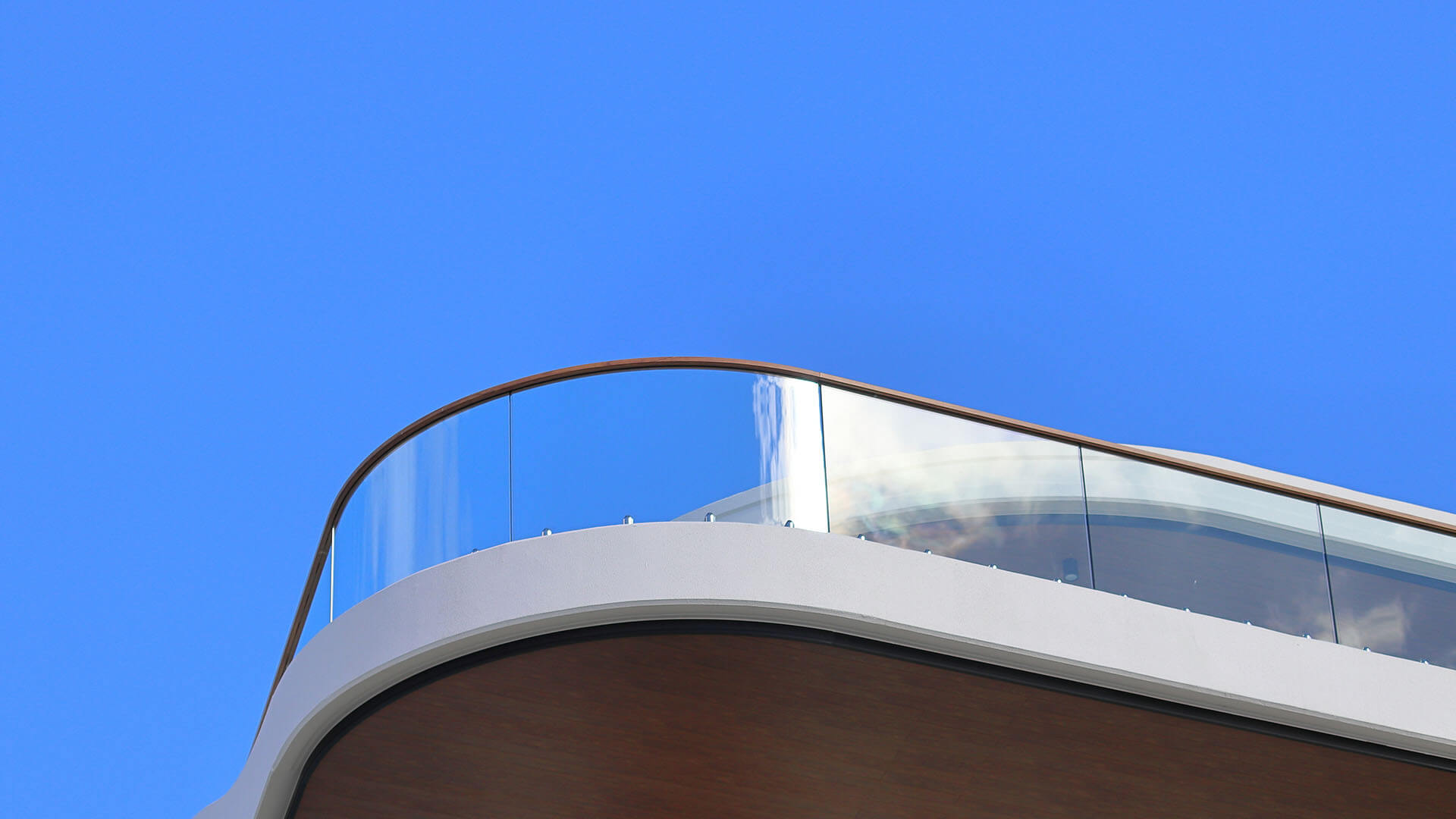
In office buildings, shopping malls or exhibition spaces, curved-secure glass facades offer a fluid aesthetic and excellent resistance to wind pressure. The curved shape allows an even distribution of stresses, reducing stress on fastening systems.
Glazed roofs and domes
Glazed domes made of curved-secure glass provide a natural flow of light and superior protection against the weather. Transparent Design’s glass sheets offer customized solutions for atriums and public spaces.
Partitions and curved interior walls
In interior spaces, curved-secure glass helps create fluid volumes without visible edges. With partitioning glass you can separate functional areas without reducing visibility and brightness, achieving visual continuity and refinement.
Shop windows with strong visual impact
In retail, curved shop windows offer a unique visual experience. The rounded shape eliminates unwanted reflections and enhances product visibility. In addition, tempered glass provides added protection against impact or vandalism.
Interior or exterior railings and stairs
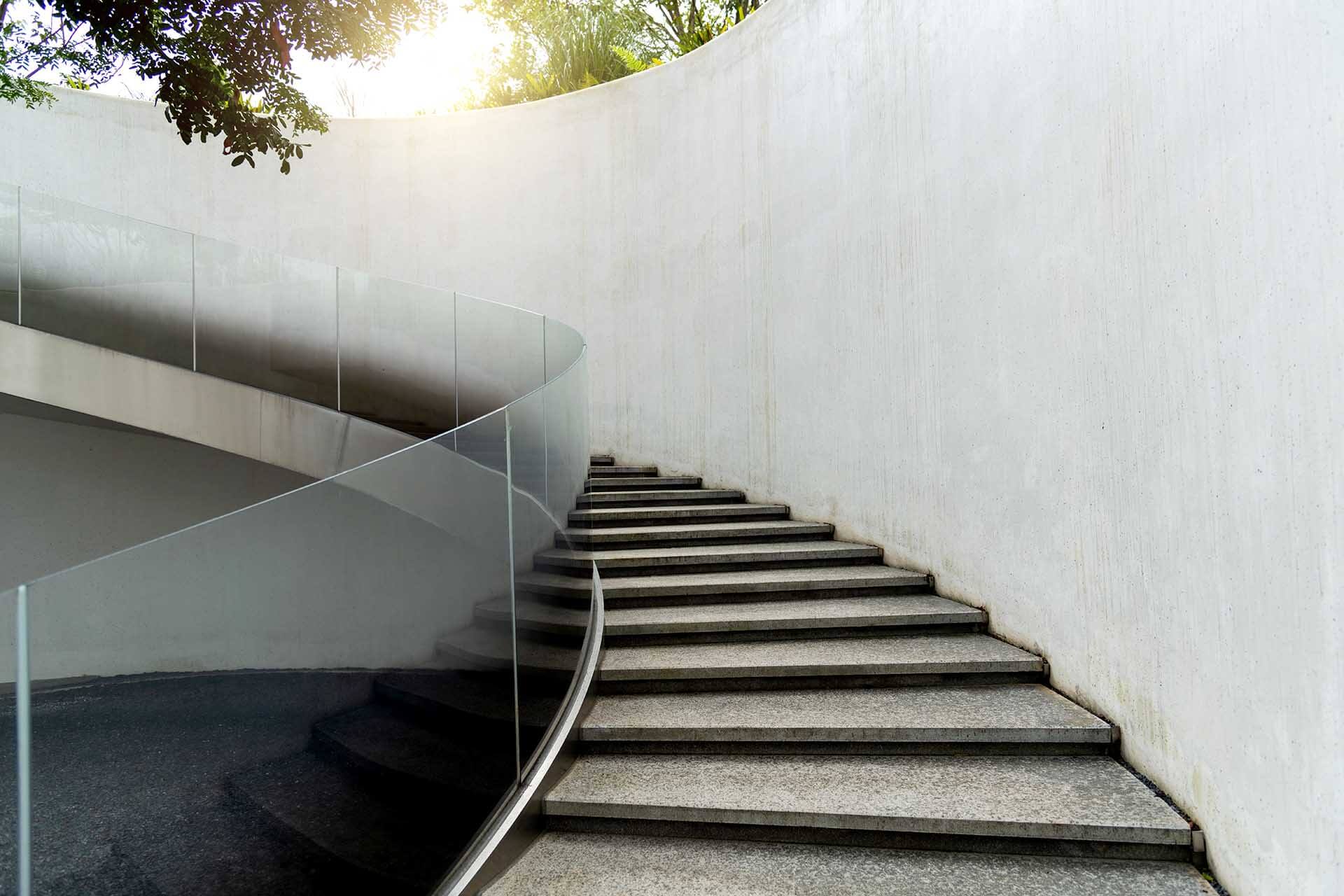
For glass balustrades interior or exterior, curved-secure glass offers a continuous design without visual interruptions. You can choose laminated versions for extra impact resistance, ideal for high-traffic areas.
Exhibition protection panels
In museums, galleries or auditoriums, curved-secure panels protect exhibits without disturbing visibility. The curved shape can be adapted to large shop windows with a discreet and elegant look.
Pedestrian or transportation tunnels with glass domes
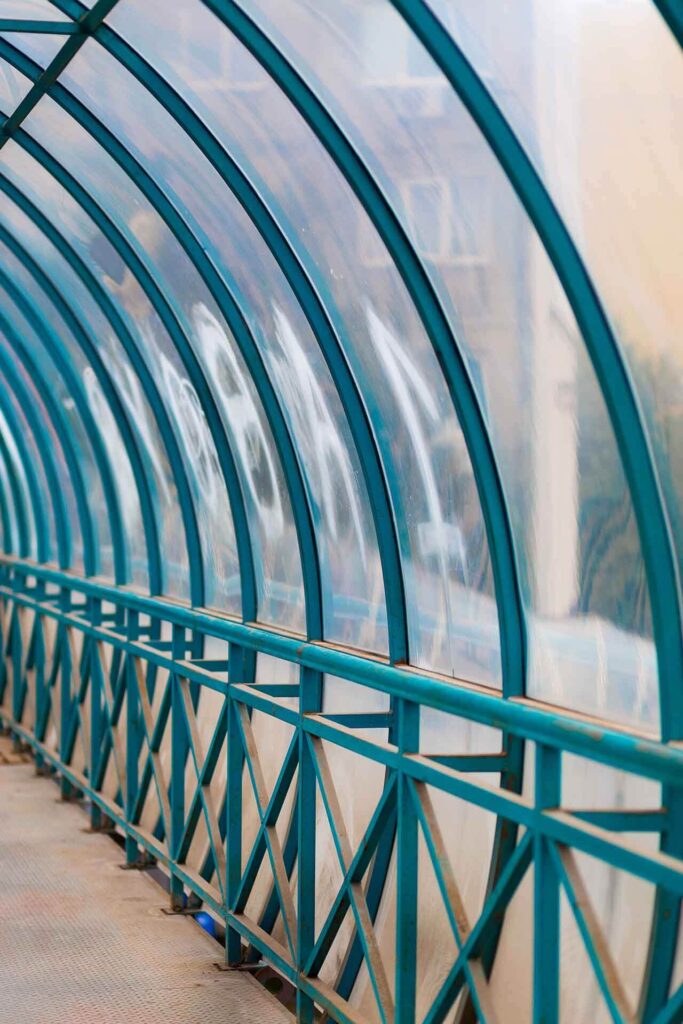
Curved-secure glass is ideal for pedestrian tunnels, covered walkways or transport terminals. Its resistance to wind, temperature variations and mechanical loads makes it suitable for infrastructure construction.
Design ideas with curved safety glass
The designers harness the potential of curved glass in large, modern spaces, using it to create natural streams of light and areas with fluid shapes. In combination with other materials, curved-secure glass opens up a wide range of creative directions:
- organic shapes for office or hotel facades;
- elements of visual continuity in open-space interiors;
- elliptical handrails for monumental staircases;
- glass domes with customized geometries;
- sculptural furniture pieces in showrooms or receptions;
- transparent demarcation zones in public spaces.
Benefits of curved-secure glass for complex projects
Curved-secure glass brings functional and aesthetic advantages that contribute to the efficiency and quality of your project. Here’s why it pays to choose curved glass for big projects!
- Modern and fluid design
Eliminating sharp edges and rigid corners, the curved glass in the Transparent Design factory gives the space a natural elegance. It allows seamless integration of continuous surfaces with a coherent visual impact.
- Optimizing natural light flow
Thanks to the curved shape, natural light is evenly distributed, reducing direct reflections. In atriums, south facades and glazed roofs, it contributes to visual comfort and reduces electricity consumption for lighting.
- Improving energy efficiency
By combining with Low-E or reflective glass, you can control heat transfer and solar radiation more effectively. In this way, curved facades contribute to energy certifications such as LEED or BREEAM.
- Aerodynamics and wind resistance
The curved shape reduces wind pressure on the glazed surface, increasing the stability of the structure. It is an ideal solution for tall buildings or buildings exposed to the weather.
- Safety and structural stability
The curved glass produced by Transparent Design better absorbs mechanical forces due to uniform stress distribution. It is more resistant to impact than a flat sheet of the same thickness, which is why curved-secure glass is preferred for balustrades, exterior facades, roofs or enclosures where safety is a priority.
- Full customization
Transparent Design offers the possibility to configure the size, radius of curvature, thickness and type of glass (tempered, laminated, chemically sandblasted, etc.). In this way, you get a technical solution perfectly tailored to the aesthetic and functional requirements of your project.
Curved-secure glass is a natural direction of evolution in contemporary architecture, where fluid aesthetics meets structural performance. By choosing this solution for your projects, you benefit from an adaptable, safe and aesthetically pleasing material that can transform any space into an expression of innovation. Transparent Design offers you the experience of a complete processor, equipped with modern equipment and capable of delivering glass products products for the most complex architectural applications.